
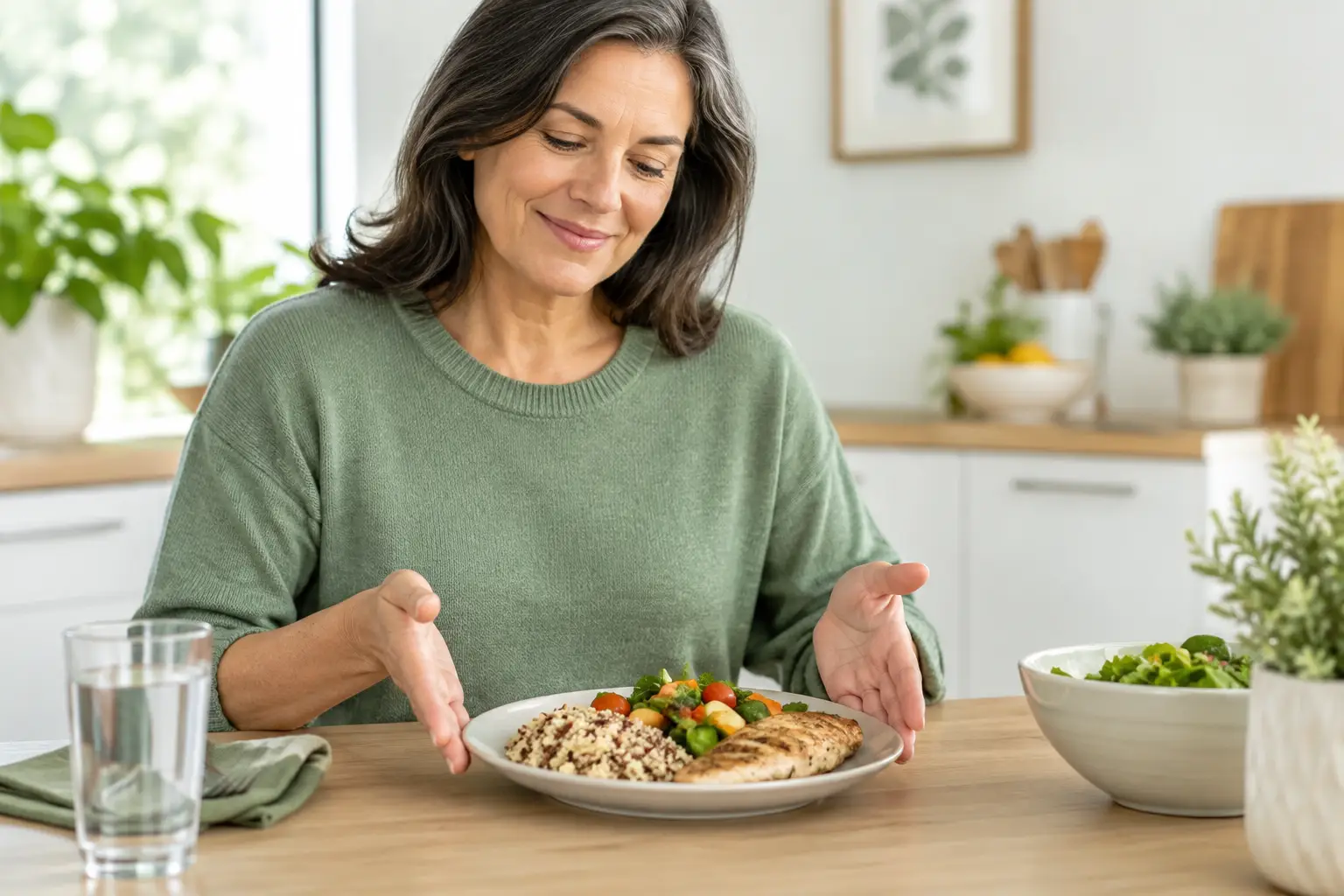
A dinner plate can look completely reasonable and still leave you hungry an hour later. Or it can look generous, satisfying, and nourishing without requiring a single calorie calculation. The difference is often not willpower. It is portion awareness without calorie counting: noticing the balance, density, and staying power of a meal before it becomes another number to manage.
For adults over 40, that skill can be more useful than trying to maintain a perfect food log. Appetite, schedule, activity, sleep, and changing routines all affect what feels satisfying. A calorie target cannot always tell you whether a meal has enough protein to support muscle, enough fiber to help you stay full, or enough volume to make lunch feel like lunch.
What Portion Awareness Actually Means
Portion awareness is not eating as little as possible. It is learning to recognize a portion that fits the meal in front of you and what your body needs that day. It asks practical questions: Where is the protein? How much of this plate is vegetables or fruit? Is there a satisfying source of carbohydrate? What is adding richness, and is it intentional?
This approach leaves room for a bowl of pasta, a burger at a cookout, or takeout on a Tuesday. The goal is not to label foods as good or bad. It is to notice whether the meal has enough structure to carry you comfortably to your next meal.
A useful distinction: serving size is a standardized amount printed on a package. A portion is what you actually choose to eat. Neither is automatically right or wrong. A packaged serving may be too little for a post-workout snack or more than you need when it is one component of a larger meal. Context matters.
Use Your Plate as a Fast Visual Check
You do not need a food scale at the kitchen counter. A plate gives you enough information to make a thoughtful call without guesswork.
At most meals, start by making protein visible. Think eggs at breakfast, Greek yogurt in a snack, chicken or tofu at lunch, salmon, beans, turkey, or tempeh at dinner. Protein supports fullness and helps adults preserve muscle as they age, especially when it is spread across meals rather than saved for one large dinner.
Then build volume with plants. Non-starchy vegetables such as broccoli, peppers, green beans, spinach, salad greens, or roasted zucchini can take up a substantial share of the plate. Fruit counts here, too. Fiber-containing foods add texture and staying power, and they make meals feel more abundant without turning eating into a math exercise.
Add a carbohydrate that matches the meal and your appetite. That might be potatoes, brown rice, corn tortillas, beans, oats, whole-grain toast, or pasta. Carbohydrates are not a problem to solve. The useful question is whether they are paired with protein, fiber, and a little fat, rather than appearing alone in a meal that leaves you searching the pantry later.
Finally, include fats with intention. Olive oil, avocado, nuts, seeds, cheese, and dressings can add flavor and satisfaction. They are also energy-dense, which is not a reason to avoid them. It is simply a reason to notice when a meal includes several rich elements at once, such as creamy dressing, cheese, avocado, and a large handful of nuts.
A Hand-Based Guide for Real Life
Your hands travel with you, which makes them more useful than measuring cups at a restaurant or family gathering. They are not a precise prescription, and they do not need to be. They offer a quick starting point when portions are hard to judge.
A palm-sized portion of protein is a practical visual cue for many meals. A cupped hand can represent a starting portion of cooked grains, beans, or starchy vegetables. A fist-sized amount is an easy reference for produce, while a thumb-sized portion can help you notice concentrated fats such as nut butter, oil, or mayo.
These cues should flex. A taller, more active person may need more food than a smaller, less active person. A long hike, an intense strength session, or a missed meal can call for a more substantial plate. So can a meal that needs to keep you satisfied through a busy afternoon. Portion awareness works because it adjusts to real life, not because it forces every meal into the same template.
Make Satisfaction Part of the Decision
The most overlooked portion signal is satisfaction. If lunch is technically balanced but leaves you distracted by food at 3 p.m., the issue may not be discipline. You may need more protein, more fiber, a larger portion of a filling carbohydrate, or simply a meal you enjoy more.
Try pausing halfway through a meal, not to police yourself, but to check in. Are you still hungry? Are you comfortable? Does the food still taste good? This is different from stopping at the first sign of fullness. Some people eat quickly because they are busy, and others have learned to ignore hunger cues after years of dieting. A short pause creates room to notice rather than react.
It also helps to watch for the opposite pattern: meals that are very large but oddly unsatisfying. This often happens with foods that are easy to eat quickly and low in protein or fiber, such as chips, pastries, sugary coffee drinks, or a bowl of refined cereal. These foods can absolutely fit into an overall eating pattern. Pairing them with something more substantial is often more helpful than trying to ban them.
How Portion Awareness Without Calorie Counting Works at Common Meals
Consider breakfast. A bagel with cream cheese may be enjoyable, but it is likely to be more sustaining with eggs, cottage cheese, smoked salmon, or Greek yogurt alongside it, plus fruit. The bagel does not need to disappear. The meal simply gains more protein and fiber.
For lunch, a large salad is not automatically satisfying. Greens, cucumbers, and a light dressing may leave you hungry if there is little protein, few beans or whole grains, and no satisfying fat. Add chicken, lentils, tuna, tofu, hard-boiled eggs, or a scoop of grain, and the same lunch has a better chance of lasting.
At dinner, think beyond reducing the starch. A plate of grilled chicken, roasted potatoes, green beans, and olive oil-based dressing can be both comforting and well balanced. If you want seconds, ask what you are still seeking. More food may be appropriate. Or you may realize the meal needs more vegetables, more flavor, or a slower pace before deciding.
Restaurant meals deserve their own rules. Portions are often larger than what you would serve at home, but that does not mean you need to eat according to a rulebook. Share an appetizer, order a side salad or vegetables, save part for tomorrow, or enjoy the full meal if that is what the occasion calls for. Awareness gives you options. Restriction tends to create an all-or-nothing mindset.
Three Steps to Build the Habit
Start with one meal you eat often. Rather than redesigning your entire week, use that meal as your practice space for a few days. Notice its protein, plants, carbohydrate, and fats. Then make one adjustment that would make it more satisfying.
Next, pay attention to patterns, not isolated meals. A pastry breakfast on a rushed morning is not a failure. But if it is followed by intense hunger, grazing, and a late-afternoon energy dip several times a week, that is useful information. The pattern points to a meal quality opportunity.
Finally, use feedback that is practical instead of punitive. BioNavs is an AI-powered meal-analysis tool that lets you describe what you ate, receive a meal-quality score, and see where protein, fiber, and overall balance may be improved. It is not another food diary, and it does not measure medical biomarkers or individual physiological responses. It helps turn everyday meals into clearer next steps.
Portion awareness gets easier when you stop treating food as a test you can fail. Build a plate that looks satisfying, notice how it carries you through the day, and adjust with curiosity. Try BioNavs to turn your meal descriptions into practical nutrition insights without counting every calorie.
Sources & Further Reading
- Dietary Guidelines for Americans, 2020-2025. U.S. Department of Agriculture and U.S. Department of Health and Human Services.
- MyPlate Plan and MyPlate Principles. U.S. Department of Agriculture.
- Protein Intake and Exercise for Optimal Muscle Function With Aging. American College of Sports Medicine.
BioNavs supports informed wellness choices. Explore the BioNavs app and the BioNavs site.